OEM Cut and Sew Clothing Factory Guide: How Should Brands Select Heavyweight Hoodies and T-Shirts?
Buyer’s Guides ·
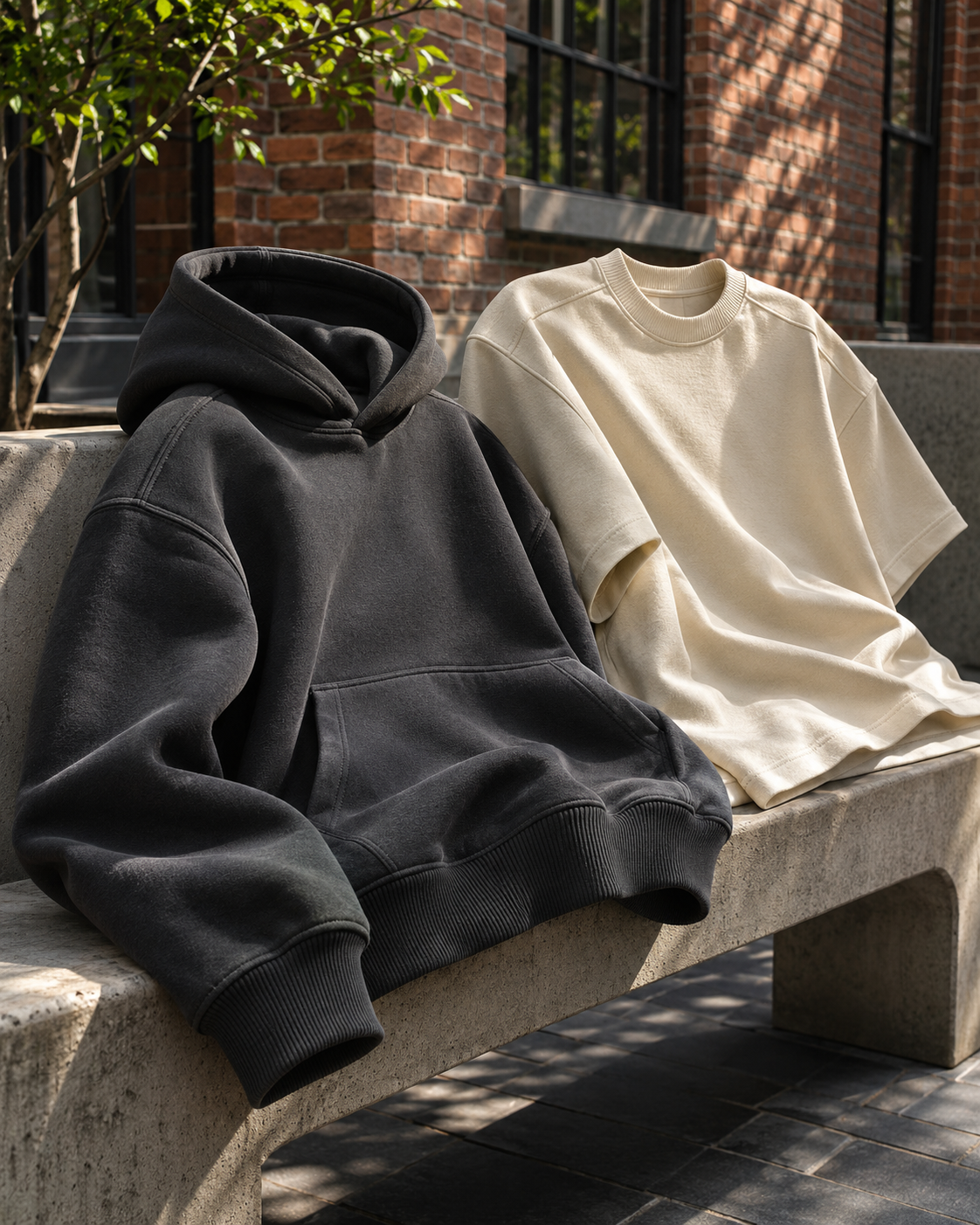
Where should a streetwear brand begin when choosing a heavyweight hoodie and T-shirt manufacturer?
Begin with the product requirements and the decisions that still need development. A hoodie may need a specific fleece construction, a substantial hood, a short body and a washed surface. A tee may depend on a stable collar, a wide shoulder and a graphic that holds the intended appearance after finishing. Write those requirements separately before deciding which supplier structure can support them. A list of factories is easier to evaluate when each candidate is answering the same technical and commercial questions. When assessing a mens streetwear clothing manufacturer in China, ask which facility will make the product and which operations are performed by partners.
Identify whether the program is a new construction, a variation of an approved garment or a repeat order. A new construction needs pattern and material development. A variation may retain the body while introducing a decoration or trim question. A repeat needs a review of what has changed since the previous approval. The proposal should identify the work required for the actual case rather than treating every enquiry as the same garment purchase.
Send the target quantity by style, color and size, together with references and the intended destination. Explain which details are fixed and where alternatives may be considered. Ask the supplier to flag assumptions about materials, artwork, finishing and packing. These assumptions affect whether two quotations represent the same product. Resolve them through development before using a preliminary estimate to authorize production.
What manufacturing responsibilities should the buyer identify before shortlisting a supplier?
Ask who will develop the pattern, source the fabric, produce the sample, perform garment finishing and approve the final product for production. A supplier may coordinate activities at more than one location. The useful question is how decisions and records move between those activities. Establish which contact owns the garment specification and how a proposed change is brought back to the buyer for approval.
Review the proposed production route for each garment. Printing, embroidery and washing may involve different facilities or schedules. Ask whether the hoodie and tee follow the same route and where separate approvals are needed. A strong development sample does not by itself identify the route that will be used for the commercial run. Request the explanation before interpreting a sample as evidence of the entire order process.
Clarify how inspection responsibilities are divided. The buyer should know who checks incoming material, how sewing issues are handled before finishing and which reference governs final appearance. Ask how an exception is documented and whether the buyer must approve it. These responsibilities should be understandable without depending on one employee remembering the history of the sample.
How can a buyer verify the route proposed for the commercial order?
Ask the commercial contact to describe the garment’s route from material selection through final inspection. Identify which decisions are handled by its own team and which involve another party. The buyer needs to know who receives technical comments, who changes the pattern and who releases a corrected sample. These responsibilities determine how the project will work after the initial sales discussion.
Request evidence relevant to that explanation. A material reference, annotated measurement chart and identified sample can show how the product has been developed. Review whether the records are consistent with the proposed bulk route. Where a sample uses an available component for development, ask which production component will replace it and what further approval will be required.
Which fabric specifications matter beyond the heavyweight description?
Describe the fiber composition and fabric construction alongside the intended mass and finish. A heavy knit can have different firmness, stretch and surface appearance from another knit with a similar stated weight. Compare candidate materials in the actual garment shape. The shoulder, hood, neckline and hem reveal how the material behaves once it is assembled and finished. Compare custom T-shirt manufacturers for streetwear brands against the same material and fit requirements. An OEM premium streetwear manufacturer should identify the production scope and approval evidence for the proposed garment.
Review the face and reverse of a fleece swatch, then compare its appearance after the proposed treatment. Check the body material with the rib and lining rather than approving each in isolation. A waistband can alter the drape of a wide hoodie, while a collar can change the way a heavy tee sits around the neckline. Record the exact material references that produce the approved combination.
Ask which material attributes are already available and which must be developed. Stock construction, custom color and custom fabric development can involve different minimums and schedules. If the supplier proposes a substitute to meet a quantity or deadline, review its effect on the finished garment. A similar color name or weight number does not establish that it will reproduce the selected appearance.
How should procurement separate capability evidence from general supplier claims?
Ask what each claim means for the proposed garment. A broad statement about premium production needs to become an explanation of the construction, material selection, finishing and approval route. Capacity needs an order-specific availability review. A certification claim needs a current document with a relevant entity and scope. Keep the evidence matched to the question rather than treating every presentation item as interchangeable proof.
Use appropriate primary sources when interpreting documents or standards. A garment dimensional-change method can support a testing plan when correctly selected and applied. A social audit concerns a facility review. A material certification has its own scope and supply-chain requirements. Ask the relevant qualified party to clarify how the evidence applies to the order and retain that explanation with the sourcing decision.
Streetwear Zhang should be assessed using the same approach. Review the actual product brief and request the documents or samples needed for it. The confirmed total capacity provides business context, while the proposed order still needs a specific review. Any claim about material availability, certification or delivery should be confirmed against current project evidence.
How should the sampling process distinguish hoodie risks from T-shirt risks?
For the hoodie, review hood size and balance, shoulder position, pocket placement, cuff recovery and hem shape. Zip styles also need the closure reviewed in the assembled garment. Heavy material can influence how these components pull against each other. Inspect the inside construction as well as the outside appearance, then try the finished sample on an appropriate wearer.
For the tee, review collar shape and recovery, neckline opening, shoulder position, sleeve proportion and hem behavior. Consider how the graphic relates to the body and whether finishing changes the intended placement. A digital mockup is useful for visual planning, while the decorated and finished tee provides the evidence needed to approve that relationship for production.
Record sample comments in terms of observations and requested outcomes. If the shoulder appears too wide, describe the fit problem and review the proposed correction with the pattern team. A change to one measurement can affect another proportion. Keep the corrected sample, measurement chart and pattern revision aligned so the production release does not combine instructions from different development stages.
What should be checked on the hood and neckline before a heavyweight hoodie is approved?
Try the finished sample with the hood down and with the hood worn. Look at how the neckline sits and whether the hood’s weight changes the position of the body. Examine the joining seam, lining and drawcord arrangement where applicable. Record whether the observed effect is part of the intended oversized silhouette or a construction issue requiring correction.
Check the same features after the proposed finishing treatment. A hood made with different layers can behave differently from the body. Inspect the relationship between the neckline, shoulder and front opening on a zip style. If the correction changes the pattern or lining, identify the new references and review the complete garment again rather than approving the component alone.
Which T-shirt collar checks help distinguish material and construction problems?
Review the collar opening, shape and relationship to the shoulder on the finished sample. Handle the neckline and assess whether it returns to the intended appearance. Look at the joining seam and the way the collar lies around the body. Compare the result with the approved reference and record whether the issue concerns collar material, dimensions, sewing or finishing.
Ask the technical team to explain the proposed correction. A different rib, revised collar length or changed assembly method can produce different effects. The approved solution should be visible on a finished tee. If the material changes later, review the neckline again. Keeping the collar reference with the body specification helps prevent a seemingly minor substitution from changing the product.
When is one OEM route appropriate for both product categories?
A shared route can be useful when the two products depend on coordinated materials, colors or finishing decisions. It can also simplify communication when one technical contact controls the specifications. Evaluate that arrangement against the actual garments. Ask which references are shared and which remain separate, and how the supplier prevents a decision made for one style from becoming an unintended change to another. An OEM cut and sew clothing factory should identify how it coordinates the approved materials, pattern and sample for bulk hoodie and T-shirt production. Buyers should compare premium heavyweight hoodies using the same material, fit and finished-sample requirements. When comparing custom heavyweight hoodies manufacturers, check which fabric, fit and finished-sample requirements are included in each quotation. Where are custom hoodies and T-shirts manufactured for the proposed order? Ask the supplier to identify the actual facility and work it performs.
Separate approval records remain valuable even when the supplier is the same. A hoodie and a tee can have different material constructions, size charts, artwork routes and inspection risks. Give each garment an identifiable revision and sample reference. Common packaging or branding details can be managed together, while the product-specific construction and fit decisions need their own control.
If different facilities are proposed for the two categories, ask how the commercial supplier coordinates them. Review the reporting route, material identification and approval responsibilities. Assess whether the arrangement meets the product and schedule requirements. The number of activities performed under one roof is less informative than a clear explanation of how the garment is developed, controlled and accepted.
How should a supplier coordinate fabric mills, decoration partners and washing operations?
Ask for one current garment specification to govern the development. The material supplier needs the construction and finish requirements. The decoration team needs the artwork, placement and intended process sequence. The washing operation needs the approved appearance and the components included in the treatment. These instructions describe different parts of one product, so the commercial supplier should explain how it keeps them consistent.
Check how a proposed change travels back through the route. If a fabric changes, decoration and washing assumptions may need to be reviewed. If the finish changes, the size and artwork approvals may need renewed attention. Identify which team evaluates the effect and who asks the buyer for approval. The record should show the final decision and which previous instructions were replaced.
Agree how samples and references will be identified when sent between parties. Include the style, size, color, revision and purpose of the sample. A garment provided for a wash experiment should not be mistaken for a final production standard. Keep experimental results distinguishable from approved references, and review the assembled finished sample before treating a combination of individually successful trials as production-ready.
What happens if the finishing partner proposes a different sequence?
Ask what the change is intended to solve and what other features it could affect. The relevant comparison is between complete finished samples produced through the proposed routes. Examine measurements, shade, hand feel, artwork and trim operation together. A sequence that improves one visible property may create a different effect elsewhere on the garment.
Record the selected route and retain the sample used to approve it. Confirm that the production team receives that instruction. If commercial constraints later make the route unavailable, review the alternative before release. A buyer can consider a different method, but it should be an explicit product decision supported by a current sample.
How should buyers organize a sample approval so comments remain usable?
Give each sample a unique identifier and connect it to the specification revision. Record which material, size, color and decoration it represents. Review it against the intended stage of development. An early fit sample may answer a pattern question while leaving color and artwork unresolved. Calling every sample “approved” without identifying its purpose creates ambiguity when production needs a final reference.
Separate observations, requested outcomes and accepted exceptions in the comments. An observation describes what the reviewer sees. A requested outcome explains the change needed. An exception states what may remain different from the original brief and where that acceptance applies. Use clear photographs and measurement points to support comments, then ask the supplier to confirm how the changes will be implemented.
After corrections, compare the new sample with the comments and the current specification. Close resolved points and identify anything still open. Avoid carrying incompatible notes from earlier rounds into the production package. The final release should be understandable without reconstructing a long message history. Retain the earlier rounds as development evidence, while making the controlling reference unmistakable.
Which changes should be treated as a new approval decision?
Review changes to the material, pattern, rib, lining, zipper, artwork, finishing route and packing requirements against their possible effects. The need for another sample depends on the change and the risk it introduces. Ask the supplier to explain the effect rather than classifying every substitution as minor. Where the effect cannot be established from a component review, assess a finished garment.
Record who approved the change and which style, color or lot it covers. An exception accepted for a specific part of an order should not silently become the standard for all future production. Make the resulting instructions available to inspection as well as production, so both teams judge the garment against the same reference.
How should buyers compare heavyweight garment suppliers against a controlled brief?
| Decision | What to confirm | Approval evidence |
|---|---|---|
| Material identity | Fabric construction, fiber composition, weight and finish | A swatch and finished sample with matching material references |
| Construction | Hood, neckline, rib and seam decisions | An assembled sample showing inside and outside construction |
| Commercial scope | Quantity breakdown, packaging and delivery basis | An itemized quotation against the current specification |
Which commercial terms should be clarified when hoodies and tees share one purchase order?
Ask whether the two styles have separate material commitments, sample approvals and production-release dates. Confirm whether either style can ship independently if the other needs another development round. Record how packing, inspection and freight are allocated when the order is combined.
Agree what happens if one style is revised or cancelled after materials are booked. Review the effect on the remaining style’s price and schedule before accepting a combined offer. Keep these commercial decisions alongside the individual garment specifications so a shared order does not obscure separate approval responsibilities.
What should a comparable quotation include?
Issue the same product information to each candidate and request the basis of the price. Confirm fabric, construction, decoration, finishing, labels, packing and quantity assumptions. Ask how material development and artwork setup are treated. Make the delivery basis and destination clear so logistics assumptions do not remain hidden in what appears to be a simple garment comparison.
Review minimum requirements at the correct level. A garment minimum and a material minimum may be different commercial constraints. A custom shade can have requirements that differ from a stock option. Ask whether those constraints apply by construction, color or style and what changes if the planned assortment is revised. Compare the resulting options against the collection plan rather than changing the product without recording the tradeoff.
When the offer changes, keep the previous revision and identify why. A revised quantity breakdown, different material or altered decoration can produce a different price and schedule. That does not make the new offer directly comparable with the old one. A controlled quotation history allows the team to negotiate with an understanding of which product and obligations are being purchased.
How should capacity and delivery claims be evaluated for an individual order?
Ask for a proposed sequence that includes material confirmation, sample approval, production release and delivery preparation. Identify which dates depend on the buyer providing artwork, comments or approvals. A factory-wide capacity statement can give context, but it does not reserve a slot for a particular assortment or finishing route. Review availability against the actual order.
Streetwear Zhang has a confirmed total capacity of up to 300,000 garments per month. The timing and available capacity for a specific order still require confirmation. Share the intended quantity, style details and destination so the proposal can be reviewed against current commitments and material requirements. Avoid building a launch date around an unconfirmed general statement.
Agree how schedule changes will be communicated. A material substitution or delayed approval may change the route as well as the dates. Ask the supplier to identify the decision needed and its effect on subsequent stages. Record revised commitments with the product specification so a rush to recover time does not silently change the garment or remove a required approval.
What should the production-release checklist contain for a mixed hoodie and tee order?
Build the release around the individual styles and their shared requirements. Confirm quantities, sizes, colors and product revisions. Identify approved materials and trims, finished measurement charts, artwork and placement records, wash standards and packing instructions. Mark which references are common and which apply to only one garment. This is especially important when similar color names or artwork files appear across the assortment.
Review whether every approval has been made on the inputs proposed for production. Where a remaining item is unresolved, identify the work it prevents and the evidence needed to release it. A buyer may allow independent preparation to continue, but the boundary should be clear. Avoid authorizing irreversible work on an assumed specification simply because other portions of the order are ready.
Confirm how the release is communicated. Ask which team receives the approved references and how revisions are controlled. If the order is split across production groups, check whether they have the same relevant standards. A release meeting or written confirmation is useful when it results in a clear record of the garment and decisions being authorized, rather than a general statement that the order can proceed.
How should packaging and labeling be checked without losing focus on the garment?
Keep packaging and labeling references in the same product file while identifying their own approval points. Check wording, placement, size identification and any market-specific instructions with the responsible team. A correct garment can still arrive with an incorrect size label or packing arrangement. Approve the actual references proposed for the order rather than relying on an earlier generic example.
Make clear which checks must happen before components are ordered and which happen during packing. If the brand changes artwork or wording, record the revision and address any obsolete stock. For product claims, obtain the relevant evidence before approving printed labels. Do not infer a certification or material claim from an unverified supplier description.
Which finished-garment checks should procurement discuss before shipment?
Agree the scope of the final review before the goods are ready. The relevant checks may include measurements, appearance, construction, decoration, trim operation, labeling and packing. Identify the controlling samples and documents. Where an independent inspection is required, confirm its arrangements and the information the inspector needs. A final review works better when acceptance criteria have already been resolved.
Inspect the interaction between features. On a hoodie, the zipper may operate while the front still hangs unevenly. An embroidery may look clean while making the panel too stiff. On a tee, the graphic may match the approved color while sitting differently relative to the neckline. These examples show why a complete garment review remains necessary alongside component and process checks.
Agree how findings will be reviewed and how any correction will be checked. Request clear identification of the affected styles, sizes or lots. A correction should be evaluated for its effect on the complete product. Retain the decision and verification record with the order so future discussions do not depend solely on a photograph of a defect or an informal assurance that it was fixed.
How should the team distinguish an isolated issue from a broader production question?
Ask for the finding to be described with the garment identity and inspection context. Review whether the same issue appears in related sizes, colors or production groups. The purpose is to understand the affected scope before deciding on a response. A single example can reveal a problem, but it does not by itself establish how widely that problem occurs.
Use the investigation to select an appropriate review of the affected goods. Record the result and the basis for the final decision. Avoid expanding an exception without evidence, and avoid treating one corrected sample as confirmation that all affected garments have been addressed. The supplier and buyer should agree what verification is needed for the actual finding.
What should be archived for repeat heavyweight streetwear production?
Retain the final approved garment, measurement chart, pattern revision, material references, artwork files, finishing standard and the record of any bulk corrections. Identify the order to which the references apply. The archive should allow a different member of the team to understand the approved result and distinguish it from earlier development options.
On a repeat order, ask what has changed. Material lots, components, finishing arrangements and available colors may need a current review. Decide whether the change affects fit, appearance or construction and whether another sample is required. Reusing the product name does not prove that every manufacturing input remains the same.
Use the retained references to make that review practical. Compare the new proposal against the existing garment and records, then approve any change explicitly. A useful repeat program preserves what the brand values while checking current evidence. The records help both parties identify whether a new result is equivalent to the approved product or represents a deliberate revision.
What should a buyer decide before accepting the final manufacturing proposal?
Confirm the garment being purchased, the material and component references, the quantity structure and the development still required. Review the basis of the price and schedule. Identify the approvals the buyer must provide and the evidence the supplier must return. Make any unresolved requirement explicit before it becomes a hidden dependency during production.
Then compare the proposal with the collection priorities. Consider whether the material supports the intended feel, whether the pattern and grading preserve the silhouette, and whether the finish and decoration have been reviewed together. Evaluate the supplier’s explanation of how the order will be managed. The decision should connect the commercial offer with a product that the team can recognize and approve.
Keep the final agreement and product references together for the next stage. When a later question arises, the team should be able to identify what was selected and why. That record gives the buyer a more reliable starting point for production review and replenishment than a collection of attractive samples without controlled specifications.
Which questions should be resolved before selecting a heavyweight garment manufacturing partner?
Can the supplier explain the proposed construction and material route for each garment? Are the quotation assumptions visible? Is the production sample made with the proposed inputs? Who controls changes and inspection decisions? These questions give procurement a basis for evaluating the offer beyond a broad claim to manufacture premium clothing.
Resolve the unanswered questions in the context of the order. Ask for the specific sample, document or confirmation needed to make the decision. Keep that request proportionate to the product risk and make clear which approval it supports. The resulting record should connect the commercial agreement to a garment that the buyer and supplier can both identify.
Begin the project discussion with a complete reference package. Include the intended silhouette, materials, artwork, finish, quantity breakdown and delivery destination. State the approvals already obtained and the choices still open. This gives the proposed manufacturer a concrete brief to assess and gives the buyer a clearer way to compare its response.
Which questions should brands resolve before approving a heavyweight hoodie and T-shirt supplier?
Should hoodies and T-shirts always be placed with the same factory?
Compare the required material, pattern, decoration and finishing route for each garment. A shared supplier is useful when it can coordinate those decisions, while each style still needs its own controlled specification and approval. Ask who handles any partner operations before combining the purchase.
Does a higher GSM prove that a garment is more premium?
GSM describes fabric mass per unit area. Review construction, material, finish, recovery and the assembled garment alongside the number. Approve the wearing feel and silhouette on the intended sample; weight alone does not establish that result.
Which documents should be checked before accepting a certification claim?
Review the named entity, location, validity, product or material scope and the connection to the proposed order. Ask which records follow the actual supply route. A certification or audit description on this page does not establish Streetwear Zhang’s certification status.
Which primary sources help buyers interpret testing and responsible-sourcing evidence?
AATCC garment dimensional-change testing
AATCC identifies TM150 as a method for dimensional changes of garments after home laundering. A buyer and laboratory should agree the applicable method, conditions and acceptance criteria for their product. AATCC TM150 information
OECD garment and footwear due diligence
The OECD guidance supports risk-based review of garment and footwear supply chains. Use it to structure supplier questions and follow-up rather than treating a document name as evidence that a particular order has been checked. OECD due diligence guidance
OEKO-TEX STANDARD 100
The official standard describes textile testing for harmful substances. Check the actual supplied document and its scope when assessing a proposed material or garment claim. Official STANDARD 100 information
Sedex SMETA
Sedex describes SMETA as a worksite audit approach with two-pillar and four-pillar scopes. Review the applicable report, location, findings and follow-up when considering the facility proposed for an order. Sedex SMETA information
Explore custom T-shirt manufacturing · Explore custom hoodie manufacturing